


Why Queendom Deserves a Spot on Your Thai GL Watchlist 👑
Updated: Jan 18
Queendom is one of those Thai GLs that quietly snuck up on me. What initially feels like a familiar body-swap story unfolds into something more introspective, emotionally grounded, and surprisingly tender.

Beneath its fantasy setup, Queendom is a story about identity, power, healing, and what it means to be truly seen, not just by someone else, but by yourself.
Rather than relying solely on romance or shock value, the series takes time to explore its characters as people shaped by their environments, mistakes, and the expectations placed on them.

Queendom is also an ode to self-love. It doesn’t just tell a love story about two people; it also shows the transformative power of giving yourself that love.
Spoiler alert: Contains minor spoilers for Queendom
Finding Yourself Through Someone Else: Everything I Loved About Queendom Thai GL

Table of Contents
Watching Beyond the Body Swap
If the idea of characters falling for someone who’s in their body feels weird, I assure you that reaction is completely understandable. Even the characters expressed discomfort about it in episode 7:

I felt the same way, but what helped was reframing how I looked at the body swap. Instead of focusing on the physical image, I thought of it like watching yourself in a video:
You recognize the face, but the person you’re observing feels separate. You’re noticing expressions, choices, and emotions rather than identifying with the body itself.
Rey (Arhoung Nattawadee) and Print (Pam Tarradee) aren’t falling in love with their own bodies — they’re falling for the person inhabiting them.

Once I watched it that way, the discomfort faded, and the romance felt more natural: rooted in connection rather than appearance.
Additionally, it also helps forgetting they switched bodies. Just watch it like you would any other GL: as a story of two people who meet and develop feelings for each other.

When Confusion Becomes Immersion
One of my early criticisms of Queendom was how abruptly Rey and Print switched bodies. Because it happened so early, I felt like I didn’t know the characters well enough to fully feel the impact of the swap.

Compared to something like Freaky Friday, where generational differences make the swap instantly obvious, Queendom's body swap felt more subtle, almost too subtle at first. However, as the series progressed, that initial confusion began working in its favor.
Visual cues, like Rey wearing pink or Print adopting Rey's neutral colors, helped anchor the switch.

As their relationship develops and they become more entrenched in each other's lives, we also see their identities start to mix, with Rey wearing pink and Print wearing neutral tones.

To me, this might represent classic domestic sapphic behavior, as living with a girlfriend means having a shared wardrobe, so eventually, you start dressing alike because you borrow stuff from each other.
They even start dressing in coordinated couple outfits:

Eventually, I stopped resisting the premise and accepted what was unfolding.
Because of this, the romance never felt strange to me. I immersed myself and viewed it as two people falling in love through shared experiences rather than physical bodies.

Hidden Visual Symbolisms in Mirrors and Reflections
How Mirrors and Reflections Hinted and Revealed the Body Swap
Mirrors and reflections feature prominently in Queendom.

In episode 1, Rey and Print do a mirroring exercise, where they imitate each other’s gestures. This was an early hint that they would step into each other's perspectives.

When they woke up the next day, their mismatched mannerisms already hinted that something was off.
However, the body swap is only fully revealed when they look into the mirror and realize it isn't their face reflected to them.

Photobooth as Spaces of Intentional Reflection
The photobooth also feels like a part of this symbolism. Unlike mirrors, which confront you instantly, photobooths are spaces of intentional reflection.

You step inside knowing you’ll be seen, captured, and preserved. Photobooths make you wait to see yourself, and you have to accept whatever version of you it captures.
Early on, Rey and Print treat the photobooth as a possible solution to their body swap.
During this time, they were also still in the 'rivals' part of their rivals-to-lovers storyline.

But as the story progresses, the photobooth’s meaning shifts.
In episode 7, they duck into it to shield themselves from the rain, and the photobooth is no longer about reversing the body swap.
Instead, it becomes a small, private space where they can exist without performance, expectation, or judgment.

Inside the cramped booth, there’s no audience: just two people sitting with versions of themselves they’re slowly learning to accept.
Their relationship has also taken a dramatic turn, and as they develop feelings for each other, everything looks brighter.
Visually, we see the change inside the photobooth, from dull (ep. 1) to vivid (ep. 7).

The photobooth represents a gentler form of self-reflection. Unlike a mirror, it doesn’t demand immediate recognition. It allows time and captures moments as they are, imperfect and fleeting, as if saying: this version of you is worth keeping too.

Finding Self-Love Through Another's Eyes
Together, the mirrors and the photobooth trace Rey and Print’s journey toward self-love. The mirror forces them to confront who they are, or who they think they are.

The photobooth, however, lets them sit with who they’re becoming.
By learning to accept their reflection through someone else’s eyes, they learn to love themselves. Rey and Print are literally falling in love with themselves through someone else’s eyes, a reminder that love can be learned from others, but ultimately, we also have to give it to ourselves.
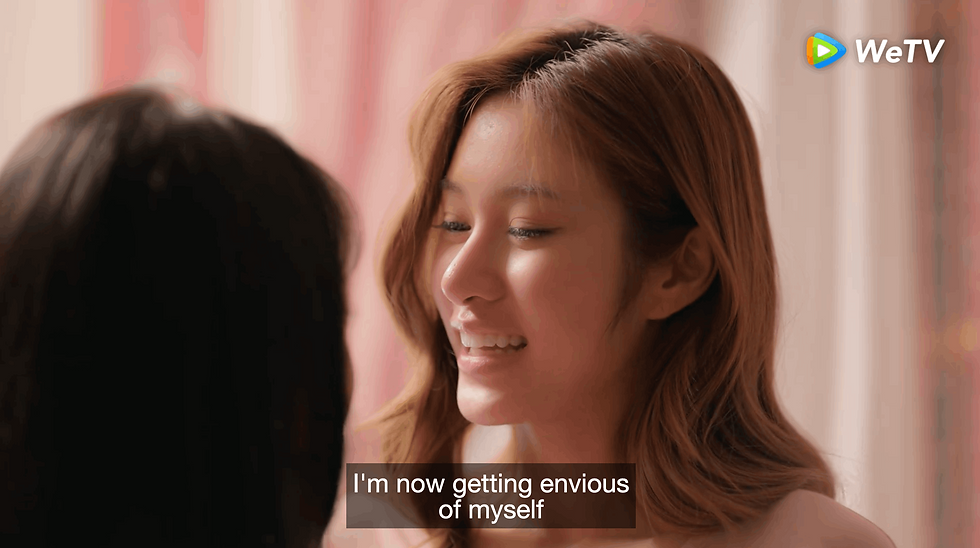
Beyond a love story between two people, Queendom also explores how meeting someone could help you see yourself from another perspective and grow from that experience.
The body swap literally made that happen because Rey and Print were able to see their lives play out as bystanders rather than the ones actually living them.

What makes this especially effective is how the series uses mirroring not just visually, but emotionally.
While living Rey's life, Print was able to understand her deeper, allowing her to rethink misconceptions she held about Rey's privileged upbringing.

On the other hand, Rey was able to experience a healthier family dynamic in Print's family.
Upon seeing how passive Print's mother was, Rey understood how not standing up for yourself could harm not just you, but the people around you.

They don’t just mirror each other; they reveal blind spots the other couldn’t see alone.
Controlling Mother Trope Done Right
The controlling parent isn't a new trope in Thai GL, but Queendom is one show that does it right.
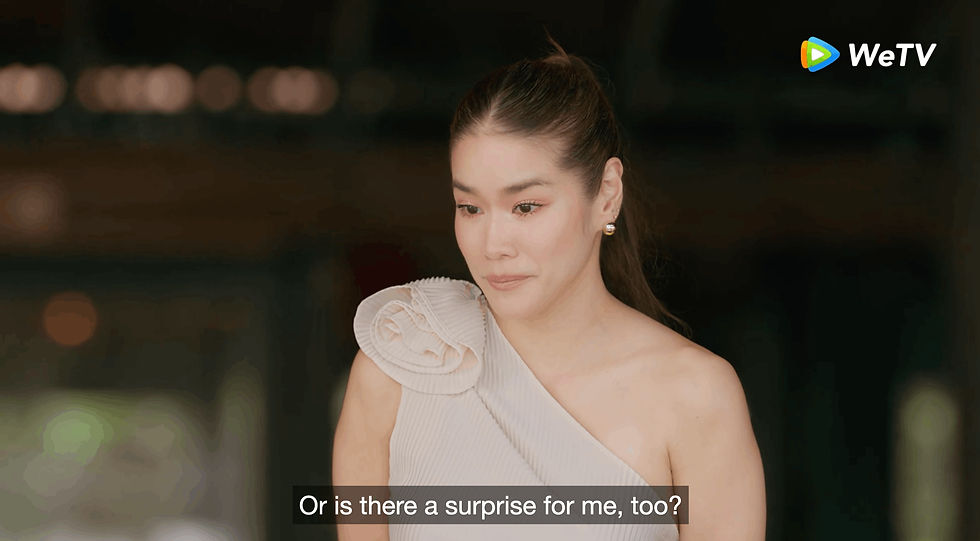
In some cases, parent storylines aren't fully developed and don't serve a purpose other than adding another external obstacle to the love story.
Queendom doesn't fall into that trap because the controlling parent, Rey's mom (Kob Pimalrot), adds context and depth to the story.
Since the plot explores how the characters develop over time, it's essential to understand their personalities, and a big part of how they turned out is parenting.

Because of her mom's controlling behavior, Rey turned out to be submissive and not in total
control of her life.
As we see more of her mother's influence on her life, we understand why Rey turned out that way. It felt freeing to see her finally develop the skills to handle it differently.

Forgiveness as Quiet Redemption
Rey experienced cancel culture from her classmates and was bullied for receiving advantages because of her parents' wealth.

The event that triggered this is tied to her mother's controlling behavior, but it didn’t make the bullying any less damaging.
Rey carried the effects into adulthood, impacting her self-esteem because she felt that it invalidated all of her previous achievements.

Queendom delivers a powerful moment when Print, who was directly affected by Rey’s mother’s actions, chooses empathy over resentment.
This was a beautiful scene that showed the power of forgiveness and what could happen if someone chooses to channel that pain in a healthy way rather than turning it on themselves or others.

This moment works because it avoids spectacle. There’s no dramatic confrontation, just shared humanity. The series understands that redemption doesn’t have to be loud to be meaningful.

Love Beyond Bodies and Appearances
Queendom reinforces the idea that beyond physical attraction, love can also start from emotional connection.

By removing physicality as the foundation of attraction, the series asks viewers to focus on emotional intimacy.
The result is a romance that feels sincere, intentional, and deeply human.
Age-Diverse Queer Representation
The inclusion of an older side couple, Wanmai (Linn Mashannoad) and Saifon (Praew Chermawee), is a welcome departure from the youth-centric focus of Thai GL, as both actresses are in their 30s.

Queendom acknowledges that queer love exists at every stage of life, even in our 30s and beyond, and deserves to be shown.
I also appreciate that Wanmai and Saifon have a fully developed storyline, rather than existing solely to serve the main couple's storyline.
They had their own conflicts and resolution, so it felt like they were given a complete arc despite being a side couple.

I'd love to see Linn and Praew in another show, especially since we don't see a lot of actresses in their 30s in Thai GL, which could also feed the toxic ageist perspective some fans hold, and worse, hurl at actresses:
Pulling Back the Curtain on Celebrity Culture
Queendom doesn’t shy away from the darker realities of fame: anti-fans, invasive shipping culture, rigid public images, and the sexualization of actresses under the guise of support.

Rather than treating these as side issues, the series integrates them into its emotional stakes, offering a thoughtful critique of the industry. It also ties back to the visual imagery of reflections.
Reflections and the Loss of Ownership of Self
In Queendom, reflections don’t just symbolize self-discovery, but also represent the exposure and loss of control that celebrities endure.

When Rey and Print look into mirrors, step into the photobooth, or film each other, they're choosing how and when to be seen, making these moments intimate and self-directed.

In contrast, several scenes show their reflections through phone screens, recording without their consent, turning their reflections into something taken rather than owned.
The photobooth was literally a safe space where they could hide from prying eyes, as the previous scene showed a stranger recording them and posting it without their consent.

This visual shift mirrors the reality of celebrity life, where images are consumed, circulated, and judged regardless of boundaries.

This is especially true in Thai GL, an industry plagued by non-consensual recording during artists' private time, stalking, and harassment.

By using reflections to contrast voluntary reflection with invasive surveillance, Queendom highlights how privacy for celebrities isn’t about invisibility, but about who gets to look, and on whose terms.
Yearning as a Love Language
This is where Queendom truly shines, in my opinion. It fully utilized the 12-episode arc to bring us a romance that doesn't feel rushed.
Rather than convincing us that Rey and Print are attracted to each other through immediate confessions or physical intimacy, Queendom allowed us to feel it through more subtle ways like meaningful looks and gestures.

Rey’s teasing paired with Print’s quiet yearning creates a dynamic fueled by restraint. This is more realistic for a rivals-to-friends, then friends-lovers arc, rather than them being passionately in love right away when we just saw them hating each other.
The series understands that yearning is a language and it speaks it fluently.

Queer Joy in the Ordinary
When Queendom allows its characters peace, it leans fully into it. Domestic moments feel soft, intimate, and grounding. Even a scene where Rey and Print are just brushing their teeth becomes a celebration of love.
This isn’t just representation for the sake of it. It’s a celebration of queer joy in everyday life.

"You make me realize the definition of 'You are me, I am you. We are bound by the souls." -Print, Episode 12

Queendom doesn’t rush its characters toward happiness. Instead, it allows them to grow into it.
I understand why some fans describe it as a 'comfort' show: Queendom is thoughtful, healing, and deeply human.

TL;DR
Queendom uses a body-swap premise to tell a moving GL story about identity, agency, and love beyond appearances. Through thoughtful symbolism, strong character development, and a slow-burning romance filled with yearning, the series explores healing, forgiveness, and self-discovery.
It stands out for handling familiar tropes with care, offering age-diverse queer representation, critiquing celebrity culture, and delivering pure moments of queer joy.
You can watch all episodes of Queendom on WeTV. Check out the trailer here:



Comments