


What the Sapphic Storyline in What Lies Beneath Revealed About the Filipino WLW Experience 🇵🇭
Updated: Jan 24
The start of 2026 brought trauma for Filipino sapphics, as new episodes of the drama What Lies Beneath featured a sapphic storyline between Louisa (Mutya Orquia) and Liezel (Kolette Madelo).
Recent episodes revealed the story of these childhood sweethearts, who met as teenagers in a small town in the Philippines.
When word got around about their relationship, Liezel's father — who's a pastor — confronted her and threatened to destroy Louisa's life if they ran away together.
Liezel asked how her father could call her “sinful” when he was also committing sins by threatening to lie and ruin another person’s life. He responds, “God will forgive me. I’m doing this for your own good.”
Liezel's father’s mindset, where people rationalize doing harmful things in the name of conservative religious beliefs, is still prevalent among many Filipinos. And they’ll fight tooth and nail to uphold these beliefs, even if it hurts the people closest to them.
In an earlier episode, Liezel tried staying away from Louisa. She said she can't be feeling the way she does, that she shouldn't feel that way about her. These feelings, which she should just feel for a boy, is how she's feeling for her friend.

Imagine having these natural, healthy feelings towards someone, but you try to push it down because you've been conditioned all your life that it's wrong, essentially robbing yourself of happiness.
The two eventually get together, but forced to break up because Liezel couldn’t see a future for them.
For me, this felt painfully realistic, especially for people who grew up in rigid environments that don’t allow you to imagine a future outside of your immediate circle.
Here are my thoughts on why this storyline struck such a chord with Filipino sapphics, and what it reveals about the typical queer experience in the Philippines.
Disclaimer: This show, and my thoughts, do not represent all Filipino sapphics. However, the fact that this storyline resonated with so many people online is proof it reflects an experience still worth representing in Philippine media.
There are many members of the Filipino LGBTQIAN+ community whose lived experiences differ. But until we see greater visibility and diversity in local media, it will remain difficult to portray the full spectrum of queer stories.
This is just one narrative, but it’s one that's still happening, hence it deserves to be told.
How a GL Side Couple Collectively Traumatized Filipino Sapphics
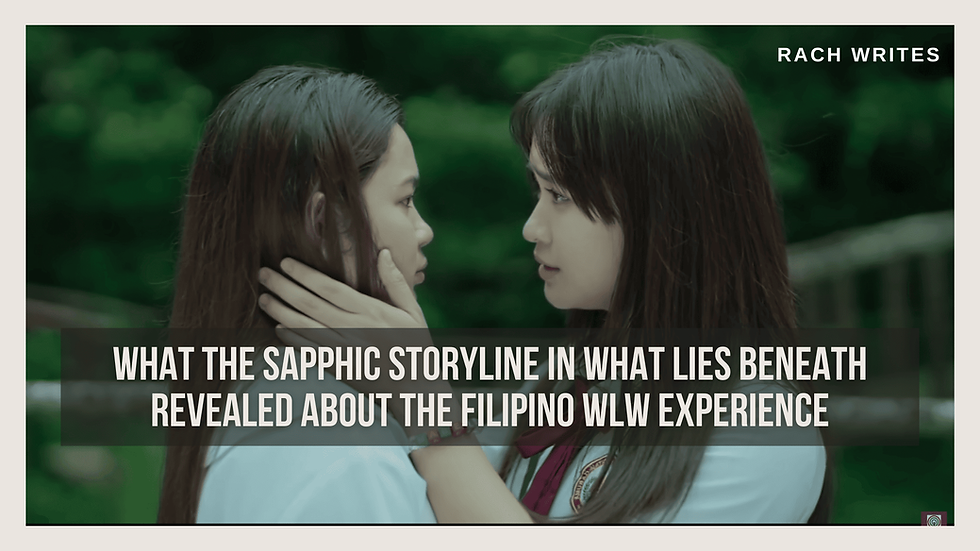
Table of Contents:
Conservative Religious Beliefs Are Still Pervasive in Our Society
While several online sources describe the Philippines as a gay-friendly destination, the reality for Filipinos who actually live there is a bit different.
Conservative religious beliefs — some which are outright homophobic — are still deeply embedded in our society.
While Louisa’s father being a pastor adds to the extremity of his beliefs, many people who don’t hold positions of power within the church still subscribe to the same mindset.

Religion is so closely incorporated into Filipino culture that it affects how we view, treat, and even legislate for LGBTQIAN+ people.
I remember how shocked my American friend was when I showed her my homeowners' association memo signed off with “God Bless.” I was so used to religion being embedded in everyday Filipino life that I forgot not every country lives the same way.
Although we try to uphold the separation of church and state, religion continues to bleed into politics.
During election season, candidates who receive the endorsement of certain religious groups are often predicted to win because of bloc voting. Whoever their religious leader supports, the entire group votes for.
The unfortunate reality is that these dominant religions often uphold conservative values, values that strip queer Filipinos of basic dignity, let alone actual rights.
Fewer Queer Representation in the Local Media
The Philippines is one of the most dedicated fanbases of Thai GL. In 2025 alone, several CPs held fan meetings in Manila, including LMSY, Faye, NamtanFilm, and GinJay.
This year, BleJie, MilkLove, and FayMay are among the CPs confirmed to visit Manila for official events.
Despite clear proof of audience demand for sapphic media, there is barely any WLW content produced in the Philippines, especially in the mainstream.
The first (and only) GL series produced by a major network was The Rich Man’s Daughter, which premiered in 2015.
Marriage Equality is Still a Fever Dream for Us
I casually watched Thai GL starting with Gap, but I’ll admit that I truly became invested after Thailand legalized marriage equality last year.
Even though I’m not Thai, I celebrated for my fellow Southeast Asians when their country became the first in the region to grant equal marriage rights to LGBTQIAN+ people.
Seeing Thai GL portray marriage between two women hits differently when their country’s laws finally reflected those stories. Unfortunately, that’s not the case in the Philippines.
Here’s a video featuring Bie Revalde, Miss Trans Global Philippines 2021 and gender equality advocate, where she discusses the state of LGBTQIAN+ rights in the Philippines in 2025, and how far we still are from marriage equality when we can’t even secure basic protections.
Why Louisa and Liezel’s Story Hurt So Much
The reason this GL side couple collectively traumatized Filipino sapphics isn’t because their story was shocking or new; it’s because it was familiar.

Many of us have seen ourselves in Liezel: the girl who loved deeply but couldn’t imagine a life beyond the walls surrounding her. Some of us have also been Louisa, watching our partner give up on a love we both want to fight for, yet having no way to promise a better future.
When queerness is treated as something you’ll “grow out of,” rebel against, or pray away, it becomes nearly impossible to imagine love surviving long-term.
Liezel didn’t leave because she loved Louisa any less. She left because society had already convinced her there was no safe place for them to exist together.
Her pain — being forced to choose between her faith, her family, and her happiness — is something many Filipino sapphics understand intimately.
Being told your love is sinful while the people hurting you believe they’re morally justified creates a trauma that lingers long after the relationship ends.
Queer Love Is Still Treated as a Moral Debate
What makes Liezel's father especially triggering isn’t just his role as a pastor; it’s how accurately he represents a common mindset: that harm is acceptable if it’s done “with good intentions.”
This belief that religion excuses cruelty continues to shape how queer Filipinos are treated by families, communities, and lawmakers. Our love is constantly subjected to moral debate, as if our existence and love requires approval.
When a parent frames control, threats, and emotional violence as acts of love, it teaches you that suffering is something you’re meant to endure quietly.
Why Representation Like This Still Matters, Even If It's Painful
As painful as Louisa and Liezel’s storyline was, it mattered.

It didn’t sugarcoat the Filipino WLW experience and didn’t offer fantasy or easy resolutions. Instead, it showed the real cost of loving another woman in a society that refuses to protect you.
For Filipino sapphics who rarely see themselves reflected in local media, this storyline —even as a side plot — felt like recognition.
It was painful, yes, but it was also validating.
The Hope We’re Still Holding On To
Despite everything, Filipino sapphics continue to hope.
We hope for better representation in local media. We hope for laws that recognize our humanity and love. We hope for families who choose love over doctrine.

Watching Thai GL flourish both onscreen and in real life shows us what’s possible when a country decides queer people deserve dignity.
Unfortunately, it also highlights how far the Philippines still has to go.
Louisa and Liezel’s story didn’t just reopen wounds. It reminded us why we continue to demand more from our stories, our society, and our future.
Because loving another woman should never feel like something you have to endure and survive.
Filipino Sapphic Shows and Movie Recommendations
For anyone interested in Filipino sapphic shows and films, I’ve created a list on MyDramaList. Some titles, such as The Rich Man’s Daughter and Pearl Next Door, offer free episodes on YouTube with English subtitles.
If you're more into films, some of the more recent releases include Open Endings, Baka Bukas, Rookie, and Billie and Emma. Hopefully, some streaming services like Netflix or GagaOOLala have it in your region. 🤞
Alternatively, Tomboy Film Club is an X account dedicated to supporting Filipino sapphic media. They have a more extensive list than mine, which even includes sapphic short films. Their posts are in Filipino, but X’s auto-translate feature works well when I checked.


Two gems from the Philippines that aren't mentioned...
Sleep With Me is excellent and on Netflix. It avoids some of the easier tropes for some excellent storytelling. It is from Samantha Lee, the writer and director of Billie and Emma.
Lei & Mar is a short independent film that I love. The creators (and MCs) are a real-life couple, Klio Manbat and Ward Reinalyn.